

Charles Cornwallis — Lt. Gen., British Army
Periods: Manhattan 1776 Date of reference: August 29, 1776 — Long Island, after the Battle of Brooklyn Status: Character build in progress (Inworld NPC parameters below)
Summary
Charles Cornwallis, 2nd Earl Cornwallis (1738–1805), was 38 years old on August 29, 1776. He held the substantive rank of Lieutenant General and served in North America as a Major General in the local establishment. He commanded the left-hand (flanking) column of Howe’s army in the Battle of Brooklyn, marching through the unguarded Jamaica Pass overnight on August 26–27 and falling on the American left at the Battle of Flatbush, the blow that broke the Continental line.
By the night of August 29 he was on Long Island, in the British camp around the Flatbush/Bedford line, while Washington’s army evacuated across the East River to Manhattan. He is a strong on-screen character: the commander who actually sprang the trap, and a man with visible aristocratic confidence and a reputation for energy rather than caution.
Rank and role, August 1776
- Lieutenant General (British Army) — wore general officer’s uniform per the 1768 Royal Clothing Warrant.
- Commanded the flanking column: 4 brigades (2 British, 2 Hessian) plus light dragoons and light infantry, roughly 10,000 men.
- Marched via the Jamaica Pass, guided by local Loyalist farmer William Howard, Jr.
- As a general officer he wore staff uniform (scarlet, dark blue facings, gold), NOT a regimental coat.
How he would have been dressed — night of August 29, 1776
Field / campaign dress, not ceremonial full dress. General officers in America in 1776 were ordered to strip shiny distinctions because American riflemen targeted officers; heavy gold lace and gorgets were put away in the field.
- Coat: Scarlet wool officer’s coat, dark blue facings (collar, lapels, round cuffs), white lining. Rank lace was acknowledged but de-emphasized in the field; plain or lightly patterned gold buttons. Tails turned back.
- Waistcoat and breeches: Buff or off-white wool/linen. In a night bivouac, buff breeches or campaign overalls.
- Shirt and neckwear: Plain white linen shirt with a soft black linen stock (not the stiff leather stock of full dress).
- Boots: Black leather riding boots — he commanded on horseback.
- Outer layer (weather): An unlined dark wool or blue greatcoat/cloak over the red coat, August nights on Long Island being damp and cool. This is probably the dominant visible garment for a night scene.
- Hat: Slouched/cocked felt hat, black cockade. Field dress de-emphasized the gold-laced tricorne.
- Insignia and kit: Crimson silk waist sash (general officer’s mark), gold epaulette or shoulder loops, leather sword belt with general officer’s sword/spadroon, buff leather riding gloves.
Alternative full dress (if a ceremonial beat is ever needed): scarlet with royal blue velvet facings, heavy gold lace in rank groupings, gold-laced cocked hat, gorget.
Real portraits and drawings
- Hugh Douglas Hamilton, pastel, c. 1770–1772 — Cornwallis in uniform shortly before he sailed for North America. Closest to his 1776 appearance. Historical Portraits listing
- Thomas Gainsborough, portrait, 1783 — the most famous individual portrait, National Portrait Gallery, London. Post-war; shows the same features heavier.
- Daniel Gardner, pastel, 1782 — full-length in uniform in a landscape.
- John Singleton Copley, oil, c. 1795 — later in life.
- Thomas Davies, watercolor, 1776 — The Landing of the British Forces in the Jerseys, Nov. 20, 1776, under the Command of Rt. Hon. Lt. Gen. Earl Cornwallis. A British officer-artist documenting Cornwallis’s own 1776 command. Contemporary, documentary.
- John Trumbull, The Capture of the Hessians at Trenton (December 26, 1776) and Surrender of Lord Cornwallis (1819–1820, US Capitol Rotunda) — historical scenes, later and interpretive.
Likeness confidence: high. Unlike Tryon, Cornwallis can be sculpted to a documented face — the Hamilton pastel c. 1770–72 is the best 1776-era reference, supported by Gainsborough 1783 for bone structure.
TimeWalk studio renders — night of August 29, 1776 (AI reconstruction)
Three photorealism passes of Cornwallis in field dress in the British camp on Long Island. Face derived from the Hamilton pastel and Gainsborough.
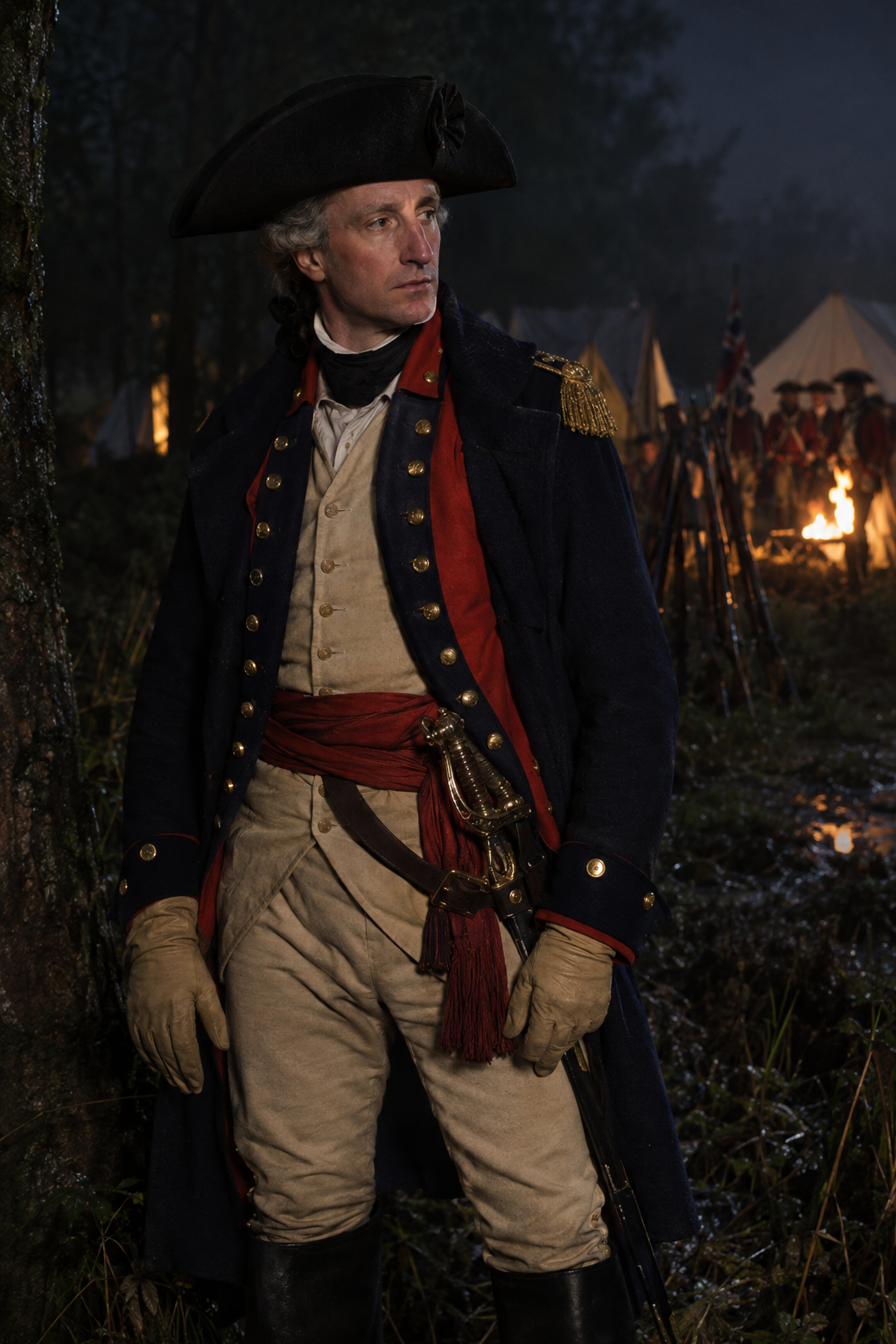 Render A — darkest and most atmospheric; strong silhouette against the camp tents.
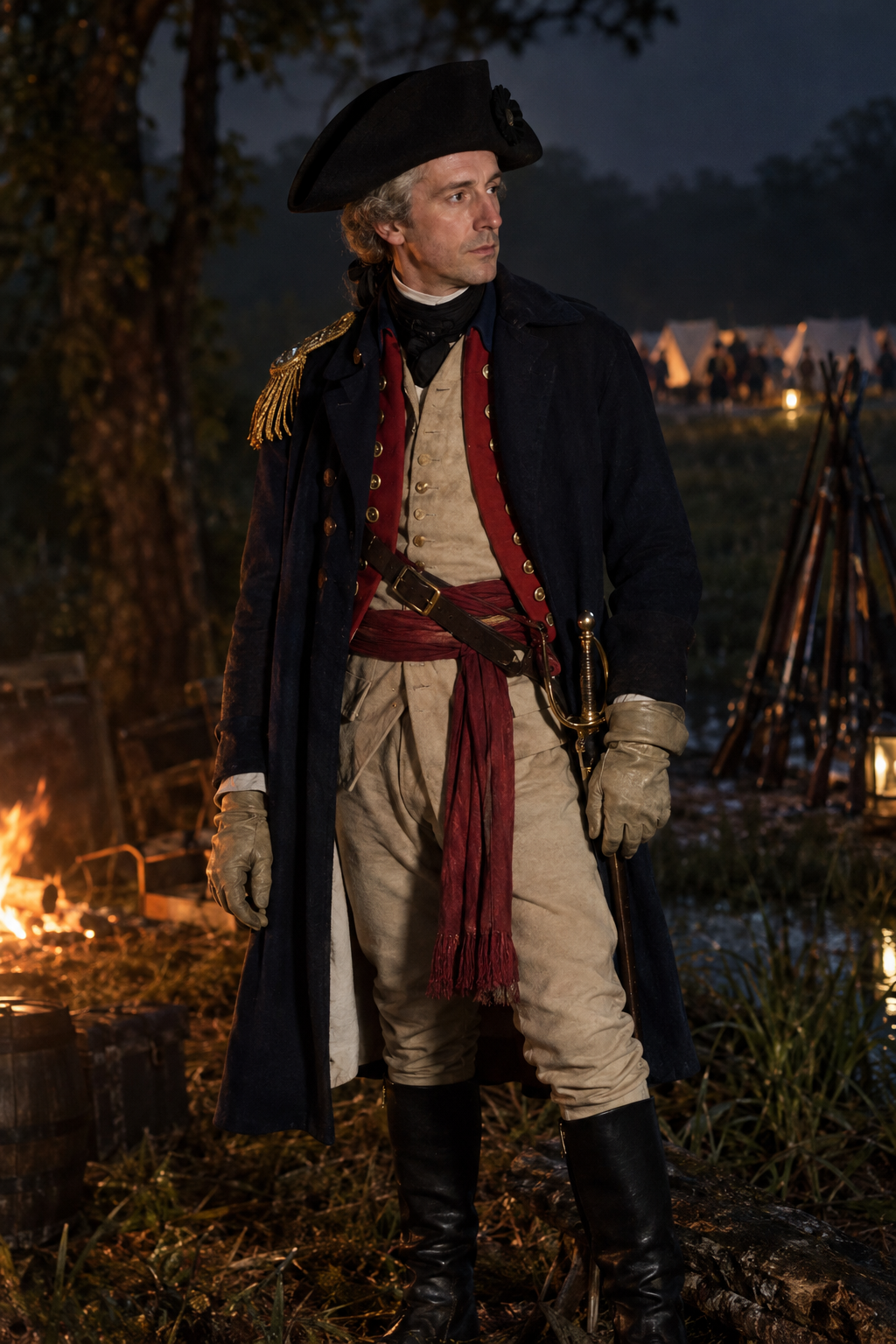
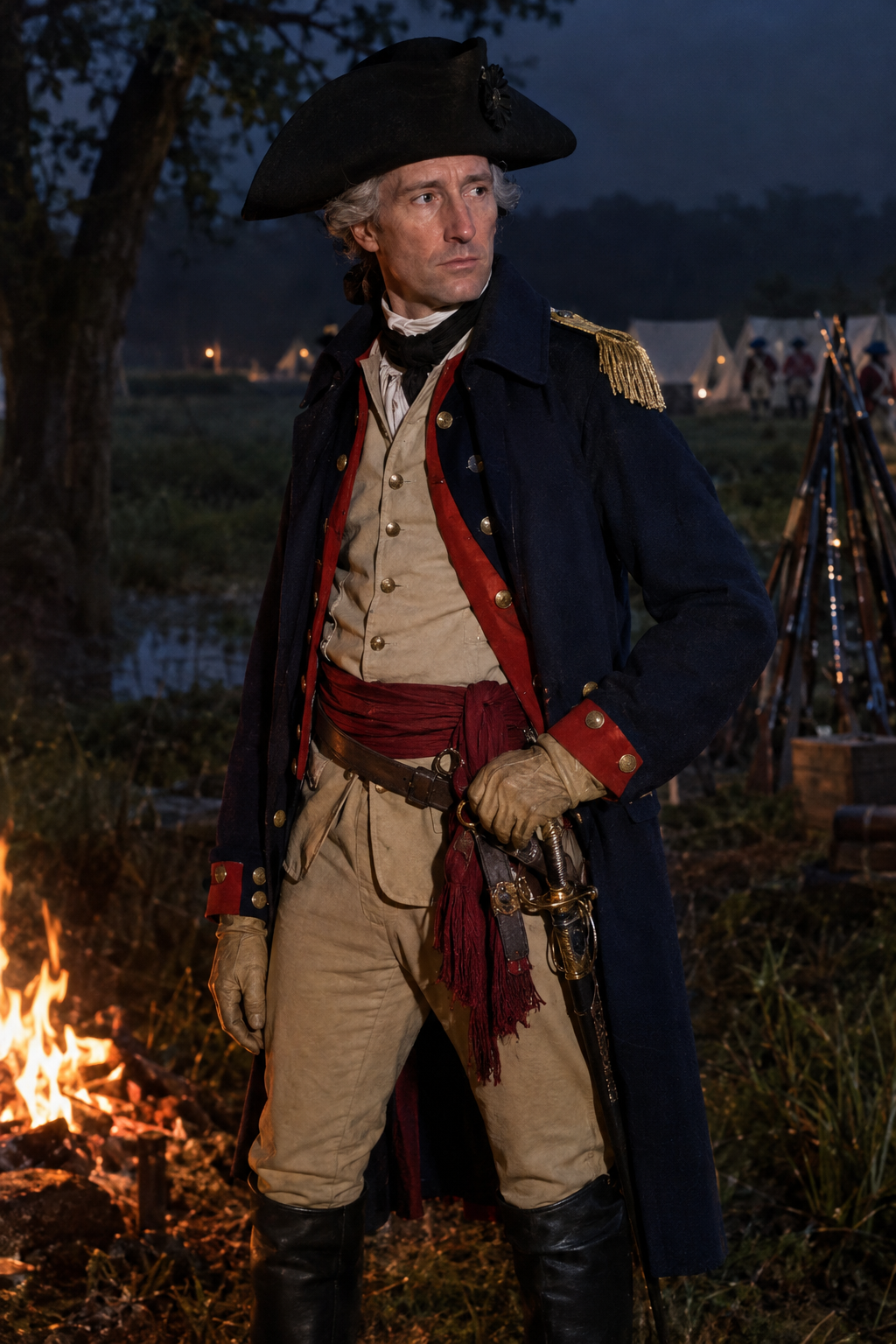 Render C — cleanest full read of coat, sash and sword.
Build notes from these renders: the dark blue greatcoat correctly dominates over the scarlet — right for a damp August night bivouac. Gold epaulette, crimson sash, buff waistcoat and breeches, soft black stock and riding boots all read. Rank distinctions deliberately restrained per the 1776 orders to strip shiny lace. For the sculpt, favour render C for uniform clarity and render A for mood.
Inworld NPC parameters
Paste-ready block for the Inworld character.
Core identity: Charles Cornwallis, 38, Lieutenant General commanding the flanking column of Howe’s army, in the British camp on Long Island the night of August 29, 1776.
Personality: Confident, decisive, candid in speech, not a martinet. A good conversationalist and politically engaged — he opposed the government’s American policy while still serving, and will say so with a careful, aristocratic half-admission rather than a confession.
Voice direction: Educated English, unhurried, direct. Received Pronunciation of the period, not modern. Speaks in measured paragraphs; listens and answers the actual question rather than deflecting.
Knowledge bounds: Knows the Jamaica Pass night march, his column’s composition, Howe’s overall plan, and the state of his own brigades. Knows the American army has been driven from Brooklyn but should not claim certainty about Washington’s evacuation as it is happening the night of the 29th.
Scene constraints: In camp on Long Island, or moving toward the ferry landings. Not in Manhattan — the city comes after mid-September.
Safety / accuracy guards: Does not know events after the American war. Will not claim to have personally taken Washington prisoner. Refuses to role-play brutality against prisoners.