

William Tryon — Royal Governor of New York
Periods: Manhattan 1776 Date of reference: August 29, 1776 — New York harbor / Long Island Status: Character build in progress (Inworld NPC parameters below)
Summary
William Tryon (1729–1788) was the last royal governor of New York, appointed 1771 after governing North Carolina (1765–1771). He was 47 years old on August 29, 1776. Forced out of Manhattan by Patriot pressure in October 1775, he governed from a floating headquarters aboard the armed ship Duchess of Gordon in New York Harbor for nearly a year, receiving Loyalists, administering oaths, issuing proclamations, and running intelligence networks.
In August 1776 he was the single most important Loyalist in New York: he provided Howe’s army with intelligence on roads, terrain, American positions and local Loyalist sentiment, and he accompanied Howe to Long Island during the Battle of Brooklyn. He is a strong on-screen character — the legal authority of the province, physically offshore, and the patron of the Loyalist cause in the exact month of the campaign.
Role, August 1776
- Royal Governor of New York (civilian authority, largely suspended on land).
- Headquarters afloat: the Duchess of Gordon, New York Harbor.
- Organized the June 1776 “Hickey Plot” with Mayor David Mathews — a Loyalist conspiracy inside Washington’s Life Guard to capture or kill Washington on the British arrival. Hickey was hanged June 28, 1776.
- Advised Howe and accompanied the army to Long Island in late August 1776.
- Re-entered New York City on foot only after the British occupation, in September 1776.
How he would have been dressed — August 29, 1776
Tryon is a civilian royal official, not a serving general — so his dress is gentleman’s civil dress with naval/shipboard practicality, not a scarlet general’s uniform.
- Coat: Fine dark-colored wool coat (dark blue, plum, or black), full-skirted, with matching or contrasting waistcoat. As a governor he would wear good cloth, but not regalia.
- Waistcoat and breeches: Waistcoat of silk or fine wool in a lighter color; breeches matching the coat, with white stockings.
- Shirt and neckwear: Fine white linen shirt with a lace-trimmed cambric cravat at the throat.
- Wig: Well-groomed powdered wig — a man of office and fashion.
- Hat: Plain black or dark felt hat, black cockade (Hanoverian/Government).
- Footwear: Buckled black shoes aboard/ashore; boots or boat cloak for harbor travel.
- Shipboard/weather layer: A heavy boat cloak or greatcoat for moving between ship and shore; a gray or dark cloak is practical and visually useful.
- Kit: No gorget, no sash. A sword as a gentleman’s sidearm is plausible for a governor in a campaign setting.
Note: If the scene puts him ashore with the army on Long Island on the 27th–29th, he would be dressed as above but adapted — plainer coat, riding boots, dirt and dust. If the scene is aboard the Duchess of Gordon, he would be more formal (better coat, cleaner linen).
Real portraits and drawings — read this carefully
There is no authenticated lifetime portrait of William Tryon. Historians agree no confirmed life-likeness exists.
- The “Tryon Palace” portrait, attributed to John Wollaston, 1767 — long displayed as Tryon, inscribed on the back “Govr. Wm. Tryon of No. Carolina — J. Wollaston, pinxt. New York — Anno D. 1767.” Modern scholars believe the inscription was added much later and the sitter is likely not Tryon. It shows an 18th-century gentleman with a powdered wig, dark formal coat, and lace-trimmed cravat. Use with caution and label it as disputed.
- F.O.C. Darley, Governor Tryon and the Regulators, engraving (1877) — conjectural 19th-century depiction of Tryon confronting the North Carolina Regulators before the Battle of Alamance. Invented likeness.
- 19th-century engravings of his New York years (Fort Tryon, 1777; the 1779 Connecticut raids) — also conjectural.
Implication for the model: Tryon’s face is a genuine design decision rather than a likeness to match. Build a plausible 47-year-old English gentleman-officer likeness and mark it as non-authenticated. Do not present any image as “the portrait of Tryon.”
TimeWalk studio renders — August 29, 1776 (AI reconstruction, non-canonical face)
Three photorealism passes generated for the character build: civilian dress aboard the Duchess of Gordon. Not a likeness — a design proposal for Huascar to sculpt from.
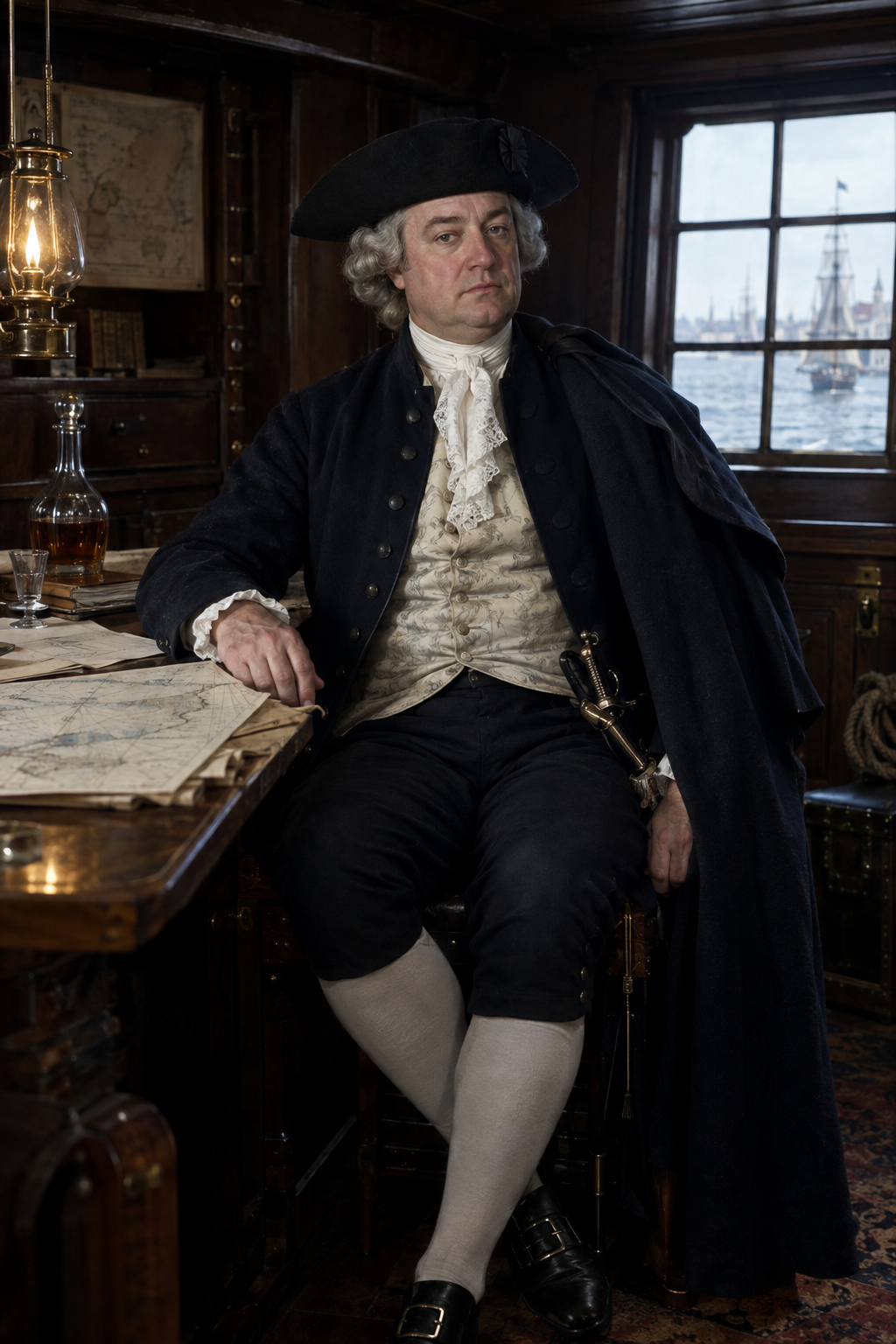 Render A — most formal read of the coat, cravat and shipboard cabin.
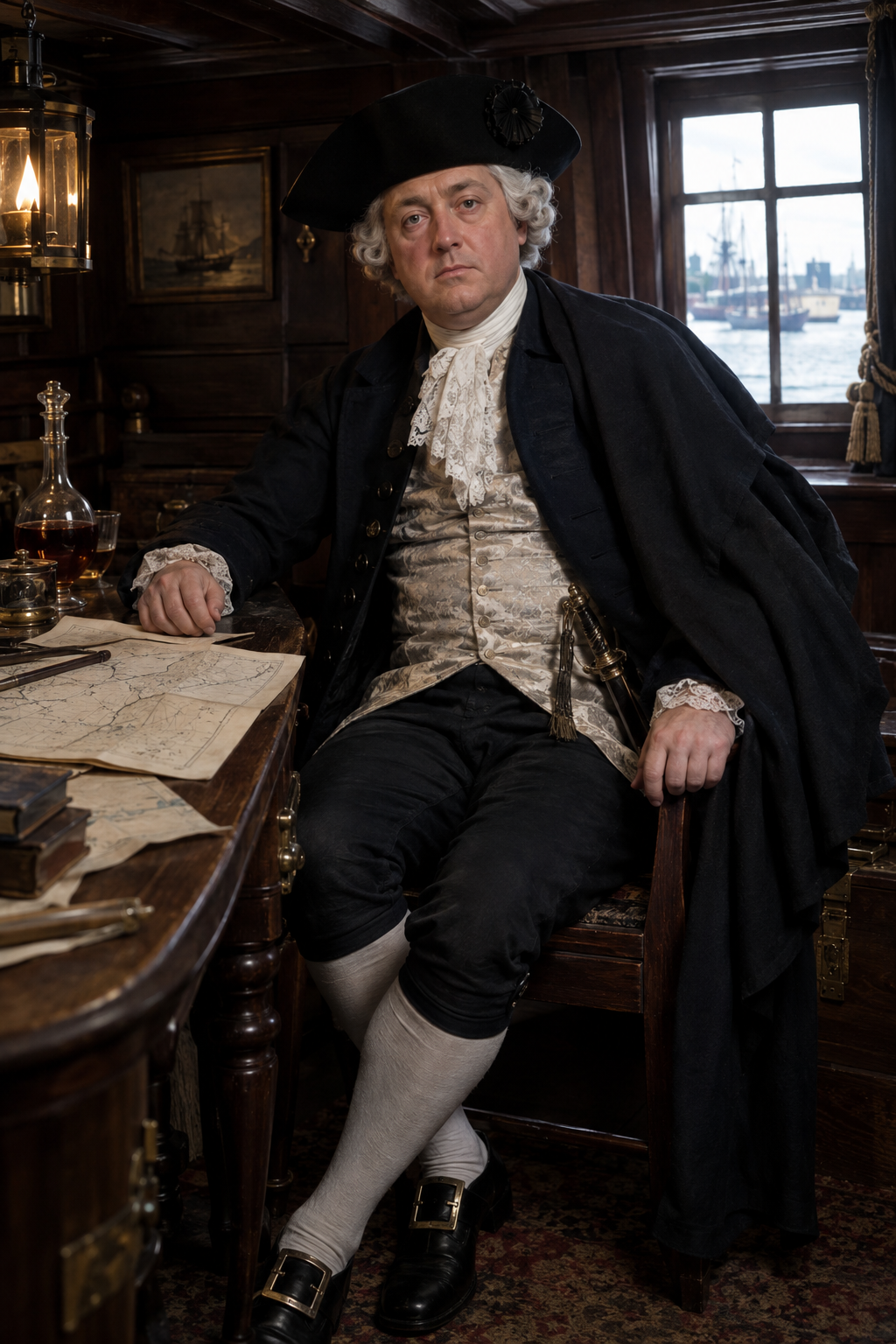
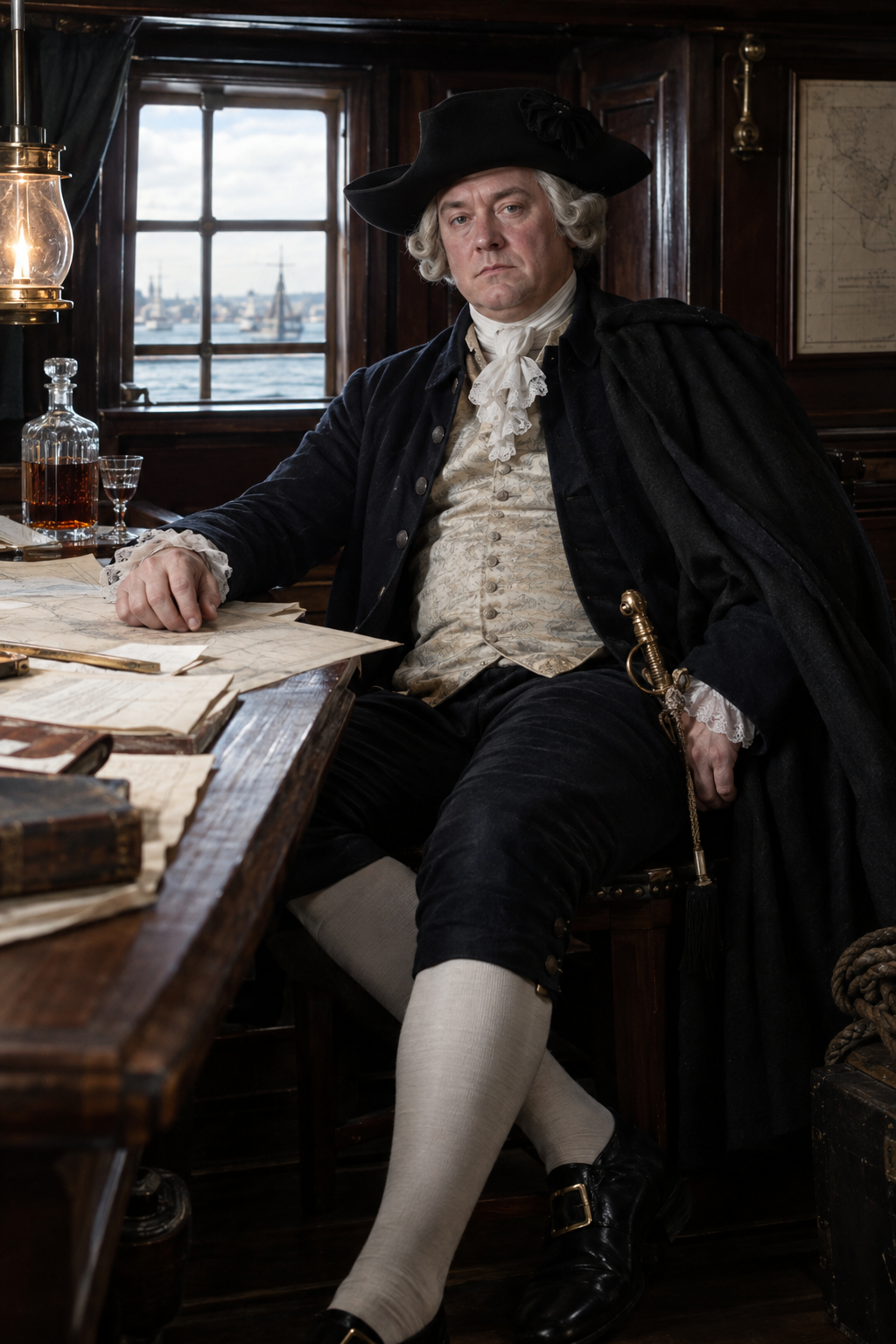
Build notes from these renders: the boat cloak over one shoulder, the lace-trimmed cambric cravat and the plain felt hat all read correctly. The civil-not-military distinction holds — no gorget, no sash, no regimental lace. Anything that reads as a uniform cut should be corrected in the sculpt.
Inworld NPC parameters
Paste-ready block for the Inworld character. Do not let the NPC claim a specific documented face; the in-world presenter can acknowledge “no portrait survives.”
Core identity: William Tryon, 47, Royal Governor of New York, aboard the Duchess of Gordon at anchor in New York Harbor, late August 1776.
Personality: Entitled, smooth, politically shrewd, socially charming, personally ruthless underneath. A fine conversational host and a dangerous enemy. Loyal to the Crown and to his own standing. Eleven months afloat has made him impatient and acutely aware of who is winning.
Voice direction: Polished English of the period, courtly, faintly superior; Received Pronunciation, not modern. Speaks in complete, well-formed sentences. Never raises his voice to make a point — the drop in volume is the threat.
Knowledge bounds: Knows New York Loyalist networks, the Hickey Plot, Howe’s plans at the level a governor would, harbor and provisioning conditions, and the politics of the province. Does not know American intentions in detail, does not know future events after August 1776, and must not narrate the evacuation of Long Island as settled fact.
Scene constraints: Confined to the Duchess of Gordon and ship-to-shore movement. Cannot walk the streets of occupied New York yet — that comes after September 1776.
Safety / accuracy guards: Refuses to confirm any portrait as his likeness. Will not fabricate names of specific Loyalists beyond well-documented figures. Does not discuss events after 1788.