

Peter Stuyvesant
Periods: Manhattan 1664, New Amsterdam 1660 Lived: ~1610 (Peperga/Scherpenzeel, Friesland) – February 1672 (his bouwery, Manhattan) In 1664: Director-General of New Netherland, age ~54, one wooden leg
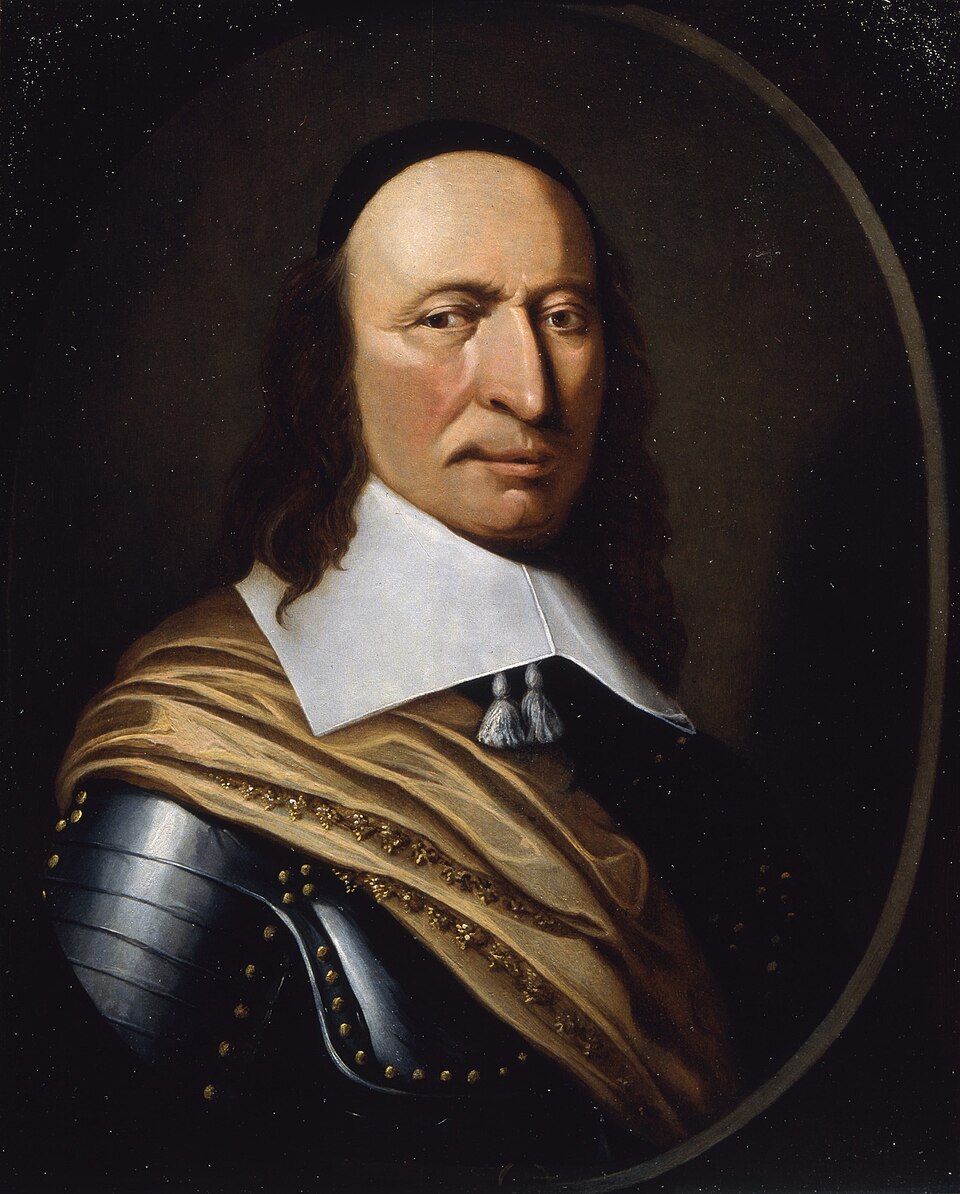 Peter Stuyvesant, attributed to Hendrick Couturier, c. 1660 (New-York Historical Society). The only life portrait; public domain, via Wikimedia Commons. See MetaHuman Likeness Reference.
Summary
Petrus “Peter” Stuyvesant was the last and greatest Director-General of New Netherland (1647–1664): a peg-legged, hot-tempered, relentlessly capable soldier-administrator of the Dutch West India Company who turned a chaotic trading post into a real city — and then, in September 1664, surrendered it to the English without a shot, over his own furious objections, because his people begged him not to get them killed. He built Whitehall, the finest house in town; ordered the wall that named Wall Street (1653); and retired to his bouwery up the island, where he died in 1672 and lies buried under today’s St. Mark’s Church-in-the-Bowery.
Early Life and the Leg (~1610–1647)
Born around 1610 in Friesland, son of a Calvinist minister, Stuyvesant joined the Dutch West India Company and rose through its Caribbean service to governor of Curaçao. Leading an assault on the Spanish island of St. Maarten in 1644, his right leg was smashed by a cannonball and amputated below the knee; he wore a wooden leg said to be banded with silver — the origin of “Old Silver Nails” and “Peg Leg Pete.” He returned to the Netherlands to recover, married Judith Bayard, and in 1646 was commissioned Director-General of New Netherland, arriving at New Amsterdam in May 1647 with the famous announcement that he would govern “as a father over his children.”
Director-General (1647–1664)
Stuyvesant inherited a drunken, brawling port of perhaps 700 souls and imposed order: he regulated taverns and fenced hogs, built a school and a proper church, gave the city a municipal government (1653, over his objections), ordered the defensive wall across the island in 1653 (Wall Street), dug the canal in Broad Street, and conquered New Sweden on the Delaware (1655). Under him the town roughly tripled, to ~1,500 by 1664 — increasingly diverse, and governed by a man with little patience for dissent: his attempts to bar Lutherans, Quakers, and the 1654 Jewish refugees from Brazil were overruled by the Company, and the settlers’ pushback (channeled by Adriaen van der Donck’s remonstrance in the 1650s) forced most of the concessions he wouldn’t give freely.
By the 1650s he lived grandly: the Great House (Whitehall) in town by the water, and a large bouwery (farm) about two miles up the island on the road that became the Bowery.
August–September 1664: The Surrender
Dates below are given New Style (N.S., Gregorian) with Old Style (O.S., Julian — used by the English, 10 days behind) noted where it matters; period English documents date the Articles August 27 O.S. = September 6 N.S.
- Late August 1664 (~Aug 26–27 N.S.): Colonel Richard Nicolls’s four English frigates — about 450 soldiers and sailors on the flagship Guinea alone — appear in the lower bay, anchoring off Gravesend/Nyack Bay, partly screened by Governors Island. Stuyvesant is in town, having just raced back from Fort Orange (Albany), where Mohawk troubles had called him upriver; the crisis catches him at Fort Amsterdam and Whitehall, not away. The fort’s southeast bastion becomes the lookout.
- The squeeze: Nicolls demands surrender, offering generous terms; English troops mass at the Brooklyn ferry; Long Island English rally against the town. The fort has ~150 soldiers and about 600 pounds of serviceable powder; the town musters perhaps 250 men capable of bearing arms out of ~1,500 people.
- ~September 4 N.S. — the rampart scene: Stuyvesant, determined to fight, stands on a bastion of the fort beside a loaded cannon as the frigates come up. Rev. Johannes Megapolensis takes him by the arm — “What good can these few guns do against that fleet? Do you want to be the first to shed blood?” — and leads him down. The famous scene belongs to the fort, not Whitehall. Shortly after, 93 leading citizens — his own son among them — petition him to yield.
- Negotiation at the bouwery: Commissioners meet to draft terms at Stuyvesant’s bouwery farmhouse up the island. The Articles of Capitulation are signed September 6, 1664 N.S. (August 27 O.S.) by six Dutch commissioners — including Johannes de Decker, Nicholas Varlett, Rev. Samuel Megapolensis, burgomaster Cornelis Steenwyck, old-burgomaster Oloff Stevensen van Cortlandt, and schepen Jacques Cousseau — and six English. (Most accounts place the signing at the bouwery farmhouse; at least one has de Decker signing aboard the English flagship — the sources genuinely differ.) The terms were remarkably liberal: property, inheritance, religion, and trade all protected. Stuyvesant himself was not a signatory.
- September 8, 1664 N.S.: Stuyvesant ratifies the Articles at the fort, then marches the garrison out with the honors of war — drums beating, colors flying, matches lit — to a ship for Holland. Nicolls renames the city New York. See British Surrender of New Amsterdam and the 1664 primary-source letters.
After the Surrender (1665–1672)
Summoned home to answer for the loss, Stuyvesant sailed to Amsterdam in 1665 and defended his conduct before the States General — laying the blame squarely on the Company’s failure to send powder, men, and ships he had begged for. Vindicated in substance if not formally, he made the remarkable choice to return to Manhattan as a private citizen, living out his days on his bouwery under English rule — his old adversaries now his neighbors and, by most accounts, his friends (Nicolls and later Governor Lovelace dined with him).
He died at the bouwery in February 1672, about 61–62, and was entombed in the vault beneath his chapel.
The Bouwery and St. Mark’s
His farm — bouwerij No. 1 — ran east of the road that took its name (the Bowery), roughly from today’s 5th to 17th Streets. In 1660 he built a small chapel on a knoll on the farm; St. Mark’s Church-in-the-Bowery (E 10th Street & Second Avenue, built 1795–99) stands on that exact site, and Stuyvesant’s bones lie in the vault beneath it — the oldest site of continuous worship in Manhattan. A pear tree he brought from Holland and planted at the farm’s corner (later 13th Street & Third Avenue) survived, famously fenced and fruiting, until a wagon collision felled it in 1867 — colonial Manhattan’s last living witness.
TimeWalk Notes
- Appearance in 1664: ~54, stout and imperious; right leg wooden below the knee (silver-banded), a rolling, thumping gait — audible on Whitehall’s stoop boards and the fort’s gun platforms. Dress: dark Calvinist finery with fine linen; breastplate and sword for the rampart scene. See MetaHuman Likeness Reference (portraits show him c. 1660, close to game date).
- Scene hooks: (1) the sighting of the English ships from the fort’s SE bastion or the Whitehall stoop, days after his hard ride back from Fort Orange; (2) the ~Sept 4 rampart confrontation with Megapolensis at the fort; (3) signing day at the bouwery farmhouse; (4) the garrison marching out with honors of war, Sept 8.
- Voice: blunt, scriptural, used to obedience; genuinely wounded by the citizens’ petition; in defeat, dignity intact.
Sources
- Russell Shorto, The Island at the Center of the World (2004) — Stuyvesant’s administration, the surrender, the return to the bouwery
- I.N. Phelps Stokes, The Iconography of Manhattan Island (1915–28) — Whitehall, the bouwery, chronology (Iconography source page)
- Peter Stuyvesant — Wikipedia — life chronology, St. Maarten, pear tree
- Articles of Surrender of New Netherland / Conquest of New Netherland — Wikipedia — signatories, dates, O.S./N.S.
- New Amsterdam History Center — 3D New Amsterdam, resident records
- St. Mark’s Church-in-the-Bowery — Wikipedia — chapel site, vault, burial
- Surrender of New Amsterdam — 1664 Primary Sources — the city fathers’ letter to the West India Company