

Aaron Burr
Periods: Manhattan 1776 Lived: February 6, 1756 (Newark, NJ) – September 14, 1836 (Staten Island, NY) In 1776: Major and aide-de-camp to Gen. Israel Putnam, age 20
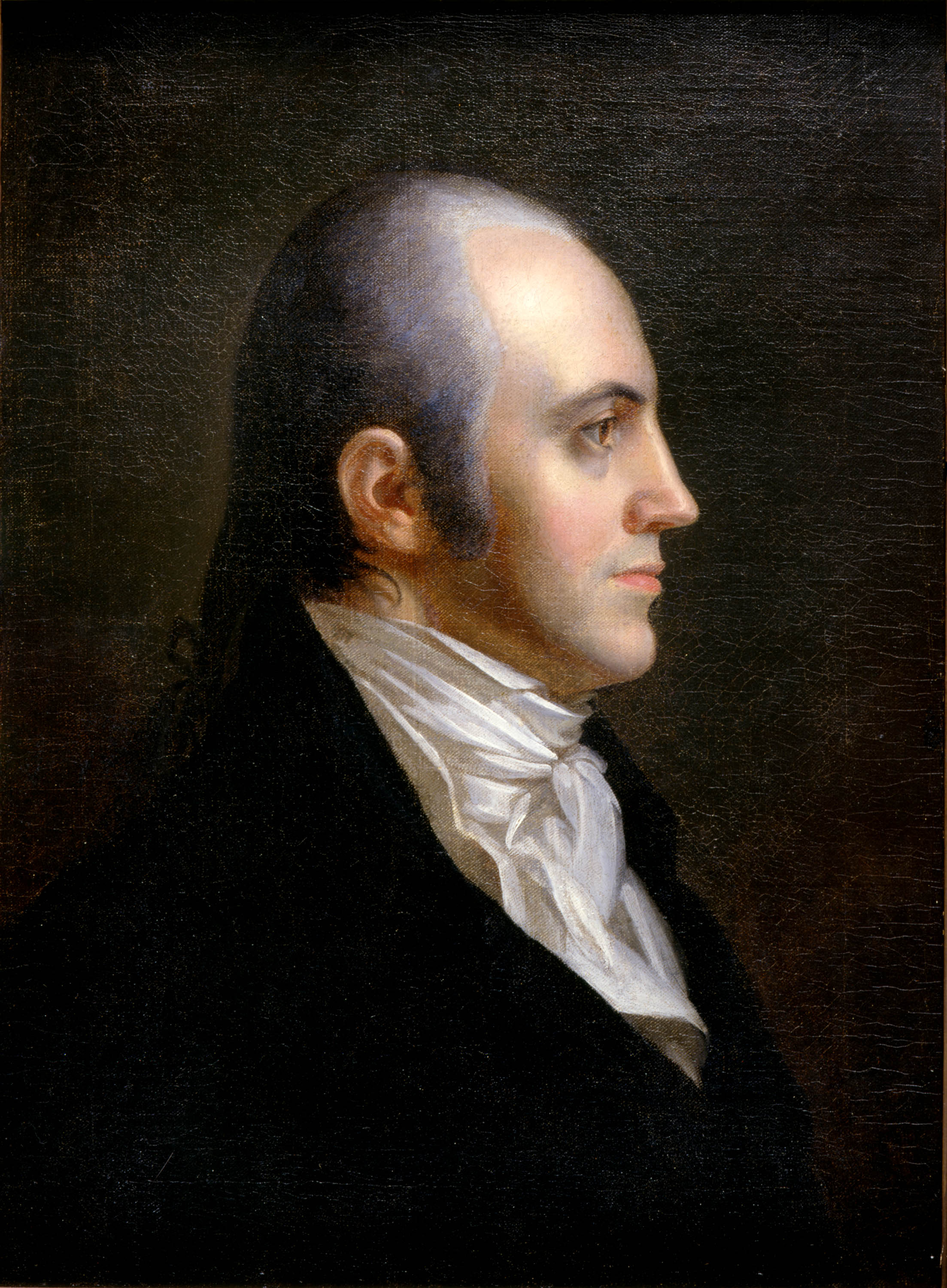 Aaron Burr by John Vanderlyn, 1802 (New-York Historical Society). Public domain, via Wikimedia Commons. Burr at 46; in 1776 he was 20 — see MetaHuman Likeness Reference for age-corrected guidance.

Summary
Princeton prodigy, Quebec-expedition veteran, 20-year-old staff officer in the 1776 New York campaign, brilliant Manhattan lawyer, U.S. Senator, and third Vice President of the United States — and the man who killed Alexander Hamilton at Weehawken in 1804. In TimeWalk’s 1776 city his signature moment is well documented: on September 15 he talked an American brigade out of making a doomed stand at the Bayard’s Mount fort and guided it up the island’s back roads to Harlem.
Early Life (1756–1775)
Born in Newark, New Jersey, into a formidable family — his father was president of the College of New Jersey (Princeton), his grandfather the theologian Jonathan Edwards. Orphaned before age three. He entered Princeton at 13 and graduated in 1772, then began legal studies that the Revolution interrupted.
Quebec, 1775–76
Burr joined the Continental cause in 1775 and volunteered for Benedict Arnold’s wilderness march to Quebec — one of the war’s most brutal treks — earning a reputation for toughness that belied his slight frame. He was in the failed assault on Quebec on December 31, 1775, close to General Richard Montgomery when Montgomery was killed; tradition has the diminutive Burr trying to carry the general’s body from the field. (The body-carrying detail is traditional and appears in sympathetic memoirs; treat with caution.)
The New York Campaign, 1776
Back from Canada, Burr served briefly on Washington’s staff (they did not take to each other), and in June 1776 was appointed major and aide-de-camp to Major General Israel Putnam, the commander in the city of New York.
The night of August 29, 1776
During Washington’s secret evacuation of the army from Brooklyn to Manhattan on the night of August 29–30, Burr was serving with Putnam’s command, and is credited with helping salvage artillery during the withdrawal. No source pins down his exact position that night — unlike his September 15 exploit, the record only places him on Putnam’s staff amid the retreat, so TimeWalk does not stage him at any specific spot. (He was not at the Bayard’s Mount fort that night; that redoubt’s August 29 story belongs to Hamilton — see Bayard’s Mount Fort.)
September 15, 1776 — the Bayard’s Mount rescue
Burr’s well-documented 1776 moment came when the British landed at Kip’s Bay and the American line collapsed. Part of Gen. Gold Selleck Silliman’s brigade — with Henry Knox among them — fell back to the Bayard’s Mount fort (Bunker Hill) and prepared to make a stand. Burr rode up and argued the position was hopeless: cut off, short of water, certain to be surrounded. He persuaded the troops to abandon the redoubt and, using his knowledge of the island’s back lanes, guided the brigade up the west-side roads to the Bloomingdale Road and north to Harlem — very likely saving it from capture. The episode rests chiefly on accounts collected in Matthew Davis’s Memoirs of Aaron Burr, so exact numbers and words deserve memoir-evidence caution, but the core event is accepted in standard histories of the campaign.
Later War Service (1777–1779)
Promoted lieutenant colonel of Malcolm’s Additional Continental Regiment (July 1777), he fought at Monmouth (1778) and commanded the exposed Westchester lines north of the city in the winter of 1778–79 — hard, thankless outpost warfare against raiders in the “Neutral Ground.” His health broke, and he resigned his commission in March 1779.
Lawyer, Senator, Vice President (1782–1805)
Admitted to the New York bar in 1782, Burr moved his practice to Manhattan when the British evacuated in 1783 and quickly ranked with Hamilton at the head of the city’s bar — the two argued cases together and against each other for twenty years, with law chambers in the same Wall Street orbit. New York attorney general (1789–91), U.S. Senator from New York (1791–1797) — beating Hamilton’s father-in-law, Philip Schuyler, for the seat — and founder of the Manhattan Company (1799), nominally a water utility for the yellow-fever-ridden city, actually a Republican bank (its corporate descendant is JPMorgan Chase). In the election of 1800 he tied Thomas Jefferson in the Electoral College; the House chose Jefferson (with Hamilton lobbying against Burr), and Burr became Vice President (1801–1805), widely praised for his impartial conduct presiding over the Senate.
Richmond Hill
From 1794 Burr held the lease on Richmond Hill, the finest estate on the lower west side — a hilltop Georgian mansion that had served as Washington’s headquarters in 1776 and John Adams’s vice-presidential residence. Its grounds ran along the Hudson at roughly today’s Charlton–Varick–MacDougal street area (the house stood near modern Charlton and Varick Streets; the hill itself was leveled after 1817 and the estate cut into row-house lots by John Jacob Astor, who bought Burr out). UE5 note: Richmond Hill is a prime period landmark for the west-side landscape — elevated site, ornamental grounds, Hudson views — a short ride north of the fortified city of 1776.
The Duel and After (1804–1836)
Hamilton’s attacks during Burr’s 1804 run for New York governor led to the challenge. At Weehawken on July 11, 1804, Burr’s shot mortally wounded Hamilton; indicted in New York and New Jersey (never tried), Burr finished his term as Vice President, then turned west — the filibustering scheme that ended in his treason trial at Richmond in 1807 (acquitted, John Marshall presiding). After years of self-exile in Europe he returned to New York in 1812 under his mother’s name, quietly rebuilt his law practice near Wall Street, and outlived nearly everyone in the story. His beloved daughter Theodosia was lost at sea in 1813. A brief late marriage to the wealthy widow Eliza Jumel ended with her filing for divorce — her lawyer was Alexander Hamilton Jr. Burr died on September 14, 1836 in a Port Richmond, Staten Island hotel, and was buried at Princeton beside his father.
NYC Sites
- Bayard’s Mount Fort (Bunker Hill) — the September 15, 1776 episode
- Richmond Hill estate — home 1794–1804, near modern Charlton & Varick Streets
- Wall Street — law practice, 1783 onward and again after 1812
- Fraunces Tavern — Society of the Cincinnati dinner, July 4, 1804: Burr and Hamilton at the same table a week before the duel
- Staten Island (Port Richmond) — died there, 1836
TimeWalk Notes
- In 1776 Burr is 20: short (~5’6”), slight, dark-haired, pale, self-possessed — see MetaHuman Likeness Reference for the sourced physical brief (restore a full hairline; the famous portraits show him decades older).
- Best documented 1776 scene hook: the September 15 confrontation at Bayard’s Mount — a mounted 20-year-old major arguing a brigade (including Henry Knox) out of a doomed fort, then leading it north through the back lanes.
Sources
- Matthew L. Davis, Memoirs of Aaron Burr (1836–37) — the September 15, 1776 episode (memoir-evidence caveat applies)
- Nancy Isenberg, Fallen Founder: The Life of Aaron Burr (Viking, 2007) — corrective modern biography; war service, law career, election of 1800
- Aaron Burr — Wikipedia — life chronology
- Landing at Kip’s Bay — Wikipedia — the September 15 panic and withdrawal
- Richmond Hill (Manhattan) — Wikipedia — the estate, its site, and its leveling
- Ron Chernow, Alexander Hamilton (Penguin, 2004) — the Burr–Hamilton rivalry and duel from the Hamilton side